Saying "I Love You" (poem)

Homer Spit

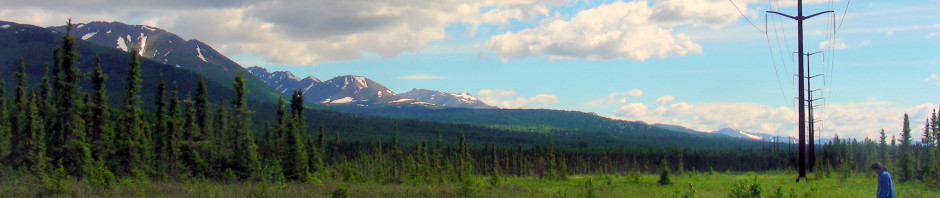
Rozz, Jesse, & a friend on Homer Spit, Homer, Alaska in 2003, some years after this poem was written.

Saying “I Love You”

Saturday I show him the video
of the trip you and I took after we
first met.  It was almost four years ago.

The tape starts with a pond along the highway
to Valdez.  There are swans, a beaver lodge,
but of you and I there are voices only.

He identifies them — “That’s you!”  “That’s Rozz!” —
but wants to see us, too.  I remember:
we hadn’t said it yet, we hadn’t touched.

Next day, there’s footage of you, a bare
couple seconds of you — “There she is!” — seated
in grass beside another pond, a near

walk from Squirrel Creek, our last night’s campsite.
The next shots were taken miles and hours away,
of Copper River as seen from the height

of the highest point on the Edgerton Highway,
then up close where, I tell him, you and I
went swimming.  He doesn’t have my memory —

he wasn’t there — for what transpired between standby
and record, between off and on — after
the glimpse of you at Squirrel Creek when I

shut down the camera.  The words were not taped
that we spoke there.  The camera didn’t witness
the first halting declarations, didn’t capture

the meeting of our hands between the car seats
as we drove the Edgerton to Copper River, where
(I do not tell him) we went skinnydipping.

That whole trip we drove from water to water,
from the Copper to Fielding Lake where glass-thin
ice tinkled downcreek past our camp; to Chena River

where mosquitoes like oil derricks examined
the shirt wrapped around your head as mosquito
netting; to Montana Creek in dark and rain,

where you made fiddlehead stew.  I fast forward through
the next morning’s endless footage — my camcorder eye
contemplating each shallow pure eddy whose slow

clarity disclosed the creek bottom lined
with pink and grey pebbles, and each turbulent
rapid with a raging surface defined

by white foam and roaring.  At the confluence
of waters, the running of creek into river,
from your separate walk you reappear in the lens —

“There she is!” — his excitement, just as I felt there,
in that moment.  Remember, love, those were the days
when we became love to one another —

and I remember, you first told me their names
in those sweet days of Bird Creek; of Captain Cook
State Park; of Anchor Point where we waded

the surf; of Homer Spit where two black dogs
swam the bay after balls the man threw.
Their names . . . the boy, his sister, their brother. . . .

A Kalifornsky Beach Road scenic overview:
he watches, with a child’s distaste and fascination,
our kiss.  He wasn’t there, he doesn’t know

that his sitting here beside me this Saturday
morning, he alone of the three, he owes
to that kiss, to those days in that landscape.

Oh, love.  Because I say it to you,
I must learn to say it to him, too.

[February 2, 1997]

About this poem

Took a rest today from thinking about the Anchorage equal rights ordinance & the politics of antigay hatred being directed at it from predictable quarters.  Mostly today I rested & read.  And then, at eight, went down to the train station to pick up Jesse, who decided yesterday to take the opportunity of a couple days off from the work he’d doing this summer at Denali National Park to make a visit home.

Home. Now, there’s a thought.  He’s not “my kid” by biological relationship, nor have we ever had a legal relationship.  And yet, home, & all because of love.

Here’s the deal.  This is a post, & a poem, about love: the love that I had (still have) for Jesse’s aunt Rozz (now Ptery), which led me into the relationship I have with him — bringing him into my family because of my love for her, learning to love him (it was quite a challenge, to begin with!) because of my love for her.

This is a post, & a poem, about politics. Because what it comes down to with issues like the Anchorage equal rights ordinance, or of marriage equality for same-sex couples, is that our love is run roughshod over by the political intrusions of hatred & intolerance.  Hatred & intolerance insists — or rather, the people who carry that hatred & intolerance, because it isn’t simply emotional but actual people who do this — these hate-filled & intolerant people insist that our lives & our loves have no worth, & take political action to prevent us from being accorded the same rights that they themselves take for granted.  (And then, true double-thinkers that they are, they even have the nerve to claim we’re asking for “special” rights.)

Terrence des Pres, writing about the political intrusions on private life, quotes Czeslaw Milosz:

The first movement is singing,
A free voice, filling mountains and valleys.
The first movement is joy,
But it is taken away.
[Ref. 1]

That’s their object: to take it away.  Let’s not let ’em.

Meantime: because of love, this boy, now grown into a young man under the care of two women who loved each other in spite of those political intrusions… now come home for a couple of days.  So there’s another reason for this post & poem: to celebrate.

I wrote this in 1997, shortly after he first came to live with us at age 9.

It’s in a rough terza rima with very slanty rhymes.

References

  1. From Czleslaw Milosz, “The Poor Poet,” quoted by Terrence Des Pres, Praises & Dispraises: Poetry and Politics, the 20th Century (New York: Penguin Books, 1989)
Posted in Marriage equality, Ordinance, Poems | Tagged , , , , , , , , , , , , | 2 Comments

Prevo's devil masks

Anchorage Baptist Temple devil man: Prevo-approved

Anchorage Baptist Temple devil man: Prevo-approved

Last Saturday evening, by way of Shannyn Moore’s blog (in a post with the ever-so-accurate title, HOW AFRAID ARE THE “Not so Jesus Christians?”), came news of a new website, www.sosanchorage.org — the SOS being an acronym, according to the website, for “Sexual Orientation Summarized.”  The site seemed to have been designed for something other than a Mac running Firefox — I wasn’t able to read any of the PDFs on the site without really working at it — but it was clear to me even at first sight that the website was a close relative of Jerry Prevo’s red herring letter of May 15 (see my May 22 post about it).  For confirmation, one only needed to click through to the “contribute now” page: one then finds oneself at the website of the Anchorage Baptist Temple being invited to further enrich Alaska’s largest church.

Rev. Prevo’s new website was first advertised in his letter to the editor of the Anchorage Daily News, posted on line on last Saturday evening & appearing in the Sunday morning print edition (May 25).  I’m not going to repeat his prevarications here; suffice it to say that they align with the prevarications, red herrings, & in some cases outright lies that have already predominated in his sermonizing, May 15 letter, website, May 26 appearance on Eddie Burke’s radio show, & anywhere else that Rev. Prevo may be heard on this issue.

But Prevo’s letter to the ADN & his new disinformation site isn’t really the purpose of this post.  It is, rather, something that was recalled to me by something Philip Munger wrote in his post a few days ago on Progressive Alaska about the letter.  Phil was criticizing the Anchorage Daily News & other Alaska media for the pass they’re giving to Rev. Prevo to spread such lies.  One might mention, for example, Jason Moore’s story on KTUU Channel 2 about the new disinformation site, in which he repeated some of Prevo’s absurdities without attempting any fact-checking whatsoever.

Oh, but wait. I was going to quote Phil’s post:

Having watched Alaska media handle Prevo coming back on this equal rights issue again now, for the third time (the 80s, with the devil costume debacle, the 90s with the Loussac windshield breakage, and now), they don’t appear to have gotten very far, if anywhere.

Ah, yes. The devil costume debacle!

I’m not quite sure Phil meant it that way, but the devil costume debacle wasn’t actually part of Rev. Prevo’s eternal war against equal rights for LGBT folks. His first battle targeting us (& the one which first brought him to political prominence in Anchorage) was in 1975. But the 1985 devil costume debacle did indeed have very much to do with equal rights — in that case, the rights of black South Africans to the most basic of human rights in the face of the whites-only government of apartheid.

I was there. I’ll tell you the story.

First I must tell you that in in college, I was active in the anti-apartheid divestment movement — or, as Wikipedia would have it, the disinvestment movement — in which college and university students demanded that their institutions divest college investments from corporations doing business with the apartheid government of South Africa. I came into the movement as a freshman, & the protests I took part in that year, 1977-78, were my first experiences of political activism. Those were the early years of the divestment movement, which lasted well into the mid- to late 1980s. As late as the fall of 1986, 50 student at my alma mater, Wellesley College, were arrested during a protest of the college’s failure to divest stocks from companies doing business in South Africa. [See reference 1 for source.]

But that was a year later & across the country, in Massachusetts, from where & when Prevo’s dance with the devil masks took place. So back to Anchorage, Alaska, August 1985: Jerry Prevo had just returned from a trip to South Africa as part of a “Freedom Mission” headed up by Moral Majority leader (& Prevo friend) Rev. Jerry Falwell. This is the same mission at the end of which Rev. Falwell denounced 1984 Nobel Peace Prize winner Bishop Desmond Tutu, stating, “If Bishop Tutu maintains that he speaks for the black people of South Africa, he’s a phony,” and called for Americans to support South Africa’s white-minority government by buying Krugerrands, its one-ounce gold coins, and by investing in companies doing business in South Africa. [Ref. 2]

At the time of the “Freedom Mission,” South Africa’s white-minority government had placed large portions of the country into a state of emergency in reaction to black demands for equal rights and an end to the apartheid system of government.  As described in the Anchorage Daily News:

Hundreds of South Africans — almost all of them black, almost all of them shot by police — have died in that violence.

Since his return, Prevo has sparked considerable controversy due to his remarks made about the trip.  The minister told reporters that South Africa’s white President Pieter Botha was a committed reformer, that blacks did not want a “one-man one-vote” democracy and that South African blacks did not want Americans to pull their investments from the country as a protest against apartheid.

Prevo and Falwell have encouraged Americans to invest in South African firms and to buy Krugerrands, South African gold coins. [Ref. 3]

What I especially remember is hearing Prevo talk about Soweto, the sprawling township designed to house white Johannesburg’s black workforce — a workforce whose members could not, by the segregationist laws of apartheid, actually live in the city where they worked. According to Prevo, Soweto’s black mayor told Falwell’s delegation that he didn’t want Americans to divest their investments from South Africa. But was Soweto’s mayor truly representative of black South Africans — more so, say, than Bishop Tutu, whom Falwell denounced?

Devil masks, part 1: Protest

August 25, 1985. Both of Anchorage’s daily newspapers (yes, we had two of them in those days) carried headlines related to the ongoing conflict in South Africa. [Refs 4–5] Meantime, reaction to statements Prevo had already made to reporters and in two televised programs [Ref. 6] about his trip with Falwell to South Africa led to the organization of a protest to be held outside the Anchorage Baptist Temple, Prevo’s church, during ABT’s Sunday services.
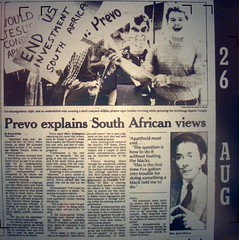
Anchorage Times story from August 26, 1985

Anchorage Times story from August 26, 1985

According to the Anchorage Times, during the service Prevo reiterated that “we are not for apartheid” and that the segregationist policies of apartheid “must be abolished,” but said that black leaders (such as Soweto’s mayor Edward Kunene) said that disinvestment from South Africa would cause blacks to starve.  He told his audience that “the real problem [in South Africa] is communism” and said that if the government of then-president P.W. Botha were to fail, communism would surely take over there. He claimed that the best route to ending apartheid in South Africa was, in fact, Botha’s government, which according to Prevo was permitting elected black leaders to manage affairs in their own communities. [Ref. 6]

Never mind that “their own communities” were themselves artificially created products of apartheid: the bantustans, designed by the National Party government to be “homelands” for black South Africans who, once forcibly relocated there, could then be stripped of their South African citizenship so that whites could eventually claim a demographic majority in South Africa proper; or segregated townships like Soweto, which existed primarily to keep the black and coloured workforce, upon which South Africa’s economy depended, accessible to South Africa’s whites-only cities, and which were created by forcibly evicting blacks and coloureds from city centers through apartheid-era legislation like the Group Areas Act.

Never mind, either, that P.W. Botha was at the time, and to the end of his life, an unapologetic defender of apartheid.  In fact, Botha was later found by the post-apartheid Truth and Reconciliation Committee to have been responsible for ordering the August 1988 bombing of the headquarters of the South African Council of Churches in Johannesburg. [Ref. 7] In its final report, the T&C Commission called the National Party the “primary perpetrator” of torture, assault, murder and assassination in South Africa from 1960 to 1994, and in particular accused Botha of leading the government “into the realms of criminality” during his presidency. [Ref. 8]

“These are elected officials… These are not puppets,” Prevo told his audience about the black representatives he had met in South Africa, whose request that Americans not disinvest he was transmitting.  “This is the first time I’ve gotten into trouble for doing something a black told me to do,” Prevo said. [Ref. 6]

“Elected officials” indeed: for example, Soweto’s mayor of the time, Edward Kunene — who, along with the rest of Soweto’s putatively democratic government, was elected by no more than 10 percent of the township’s electorate, and was seen by the vast majority of Soweto’s population as a patsy for the apartheid government. Among other signs of the township’s hatred and distrust of him: his private home was destroyed by a fire-bomb, and his official residence came close to suffering a similar fate; Kunene’s predecessor, Edward Manyosi, had been shot dead the year before. [Ref. 9] The wrongness of the violence against them does not diminish that neither Kunene nor his predecessor had the confidence of the people they purportedly led.

Besides members of the Anchorage Baptist Temple, Prevo’s audience that day included several Anchorage-area black leaders, including NAACP president Andonia Harrison, Henry M. Lancaster II, and Rex Butler, counsel for the NAACP.  [Ref. 6] It also included at least two people who later joined the protest outside: Eleanor Andrews, at the time serving as Commissioner of the Alaska Department of Administration, and Jewel Jones, director of the municipality’s Health and Human Services Department, who told the Anchorage Daily News that she’d gone to hear Prevo’s sermon because “I wanted to hear what he had to say,” but found that “What he said was worse than I’d imagined.” [Ref. 3]
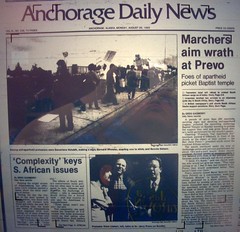
Anchorage Daily News story from August 26, 1985

Anchorage Daily News story from August 26, 1985

That’s where I was that Sunday morning: outside with the protest. Turnout for the demonstration only underscored that people in Anchorage were every bit as concerned about justice & equality in South Africa as my Wellesley friends had been. Both the Anchorage Times and the Anchorage Daily News estimated our numbers at 200, a large turnout for a Sunday morning. I remember there being a number of people from Shiloh Missionary Baptist Church,  a large predominately black congregation with strong ties to the black civil rights movement symbolized by Martin Luther King, Jr.  My friend Gennie Holubik was there, but many more people I didn’t know.  Thanks to newspaper coverage, I can name some of them: Tim Baumgardner, Bernard Wheeler, Bonnie Nelson, Drew Liebert [Ref. 6], Denise Woods (a march organizer), the aforementioned Eleanor Andrews and Jewel Jones [Ref. 3], and Mark Travers [Ref. 10].  And there was another attendee I knew: Dick Madden, pastor of my brother’s church, Immanuel Presbyterian Church, who joined the protest after preaching his own sermon at Immanuel about apartheid.  [Ref. 3]

But there were three protest attendees that none of us knew: three guys dressed in devil costumes, and all carrying signs that seemed designed to discredit the protest to motorists passing by, or at least to members of Prevo’s church.  I remember one sign in particular, that said something to the effect of, “We don’t care about South Africa, we just want to get Dr. Prevo.”  A newspaper photograph gives the text of others: “Communism is the Answer not Dr. Prevo.”  “This is my crowd. We hate Dr. Prevo.” [Ref. 10]

It didn’t take much thought for us to know these devil guys weren’t there for the same reason we were.  And we lost no time in doing something about it.  Not by an attempt to eject them, or through violence — we simply kept marching along the sidewalk at Northern Lights and Baxter, but the people to either side of the devil guys did their best to hold their own signs in front of the devil guy “Dr. Prevo” signs to hide them from passersby.  Some people also talked with them.  I remember especially one young man, not far from me, who walked beside one of the devil guys trying to engage him in conversation.  “Why are you wearing a mask?” he’d ask.  “It’s okay for you to take off your mask — we’re not going to hurt you.”  At one point I heard him talking with the devil guy about basketball scores.  I don’t know if the devil guy responded in kind.

Both newspapers mentioned the devil guys in their reports the following day.  The Anchorage Times:

The protesters, many carrying posters and at least three dressed as Satan, marched along Northern Lights Boulevard in front of the sprawling church complex. [Ref. 6]

The Anchorage Daily News gave greater detail:

They [the protesters] were joined by several men dressed in devil costumes.  The costumed men, carrying signs that alleged that Prevo opponents were Communists and satanic followers, would not tell their names to protesters who tried to debate with them. [Ref. 3]

The protest lasted about two and a half hours.  Both during the protest and afterwards, in conversations and letters to the editor, it was speculated that the three devil guys were Anchorage Baptist Temple plants.  But we had no way to prove it.

Until a month and a half later, on about October 7.

Devil masks, part 2: Prevo ‘fesses up!
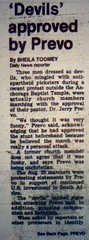
Devils approved by Prevo: Anchorage Daily News for October 8, 1985

Devils approved by Prevo: Anchorage Daily News for October 8, 1985

I think I heard it first on KTUU Channel 2 News, beginning with the start-of-the-news teaser, which as I recall said, verbatim: “Prevo ‘fesses up!” The broadcast went on to detail how one of the protesters, a former ABT member, had discovered that the devil mask guys were in fact members of Anchorage Baptist Temple.  Appalled, the protester went to Rev. Prevo to give him the bad news about their misconduct.  But to his further shock, it turned out that Prevo was in on it the whole time.

The following day, October 8, 1985, the Anchorage Daily News gave a detailed account:

Three men dressed as devils, who mingled with anti-apartheid picketers during a recent protest outside the Anchorage Baptist Temple, were actually church members marching with the approval of their pastor, Dr. Jerry Prevo.

“We thought it was very funny,” Prevo said, acknowledging that he had approved the stunt beforehand because he believed the march was really a personal attack.

… The “devils” carried signs also attacking Prevo and, in addition, praising communism and Satanism.

When asked by reporters or other protesters to identify themselves, they either said nothing or said they were from “Satan’s army.” [Ref. 10]
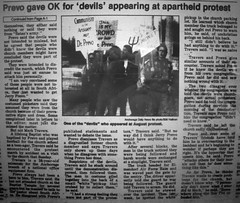
Prevo gave OK for devils appearing at apartheid protest: continuation of Anchorage Daily News story on October 8, 1985

Prevo gave OK for devils appearing at apartheid protest: continuation of Anchorage Daily News story on October 8, 1985

The story, by ADN’s Sheila Toomey, described how protester Mark Travers, 26-year-old salesman and lifelong Baptist, who had been baptized by Prevo and played football for the ABT-affiliated Anchorage Christian Schools, had seen the three devil guys jump into the back of a white pickup after the August 25 protest. Travers decided to follow them to see if he could find out who they were. Several blocks later, the devil guys realized they were being followed and “harsh words were exchanged at a stoplight, Travers said.” The white pickup continued on to the gate at Elmendorf Air Force Base and was waved through; but the MP at the gate wouldn’t let Travers through. He had no choice at that point but to give  up the chase.

But a few weeks later, he saw the same white pickup in the parking lot at Anchorage Baptist Temple. He found out who the truck belonged to and, in the words of the ADN story, “sought out Prevo to warn him, [Travers] said, of unchristian goings on behind his back.” At that point, Travers still didn’t believe Prevo had been involved. But when he asked Prevo if he had known the devil guys were ABT guys, Prevo said he did — and didn’t see anything wrong with it.  In fact, he’d been part of the devil guy thing all along.

Travers was disillusioned, telling the paper he was upset by Prevo’s hypocrisy — Prevo, he said, “attacks others for their morals and then he does something like this.”

And Prevo? His reactions and rationalizations were revelatory. He told Toomey that Travers was just a disgruntled former church member who wanted to create problems for Prevo and the church, but Prevo didn’t know why:

“I personally don’t kow what I really did to Mark,” he said. “Somewhere along the line I’ve offended him.” [Ref. 10]

By your rampant hypocrisy, perhaps?  (Are readers of this blog post beggared for words yet?)

On the deception of the devils, Prevo continued to assert no wrongdoing:

Prevo said the devils were not intended to mislead, but he agreed that people who didn’t know the devils were church members might have concluded they were part of the protest.

They were intended to discredit the march, which Prevo said was just an excuse to attack him personally.

“I am very convinced some of those people were not interested at all in South Africa, they just wanted to get Jerry Prevo.” [Ref. 10]

— which exactly echoes the devil guy sign that I most remembered from the protest.

And good grief.  The devils who were really Anchorage Baptist Temple congregants in disguise, telling reporters they were from “Satan’s army” and carrying signs that identified protesters as Communists and Satanists — these guys “were not intended to mislead”?!!!  Oh please.

(Are readers of this blog post beggared for words yet?)

There was also an interesting disagreement between Prevo and Travers:

The two disagree over whether the congregation [of Anchorage Baptist Temple] was told the devils were churchgoers, not actual protesters. Prevo said he told the congregation during services the morning of the demonstration. Travers says Prevo told him the congregation “didn’t need to know.” [Ref. 10]

Who are you going to believe? Is this one of those classic cases of he said, he said? I’m sure that most members of the Anchorage Baptist Temple would back Prevo up.

But what about the other people who were present at ABT’s August 25 service? That included, let’s see —  NAACP president Andonia Harrison, Henry M. Lancaster II, and Rex Butler, counsel for the NAACP, Eleanor Andrews, at the time serving as Commissioner of the Alaska Department of Administration, and Jewel Jones, director of the municipality’s Health and Human Services Department.  Do any of them remember Prevo telling them during the August 25 service that he had sent out three ABT members in devil masks to discredit the protest because Prevo was certain it was a personal attack on him?  No?

And let’s not forget the additional people also present at the August 25 service: news reporters, such as the Anchorage Times‘ Karen Robin, who went into great detail about Prevo’s remarks that day, but seemed just as uncertain as everybody else about who these devil guys were. [Ref. 3]

Who are you going to believe?  For my part, it won’t be Dr. Jerry Prevaricator.

Between that, & this

So is any of that ancient history stuff from 24 years ago relevant to Dr. Prevaricator’s current activities, with his red herring letter and his pack-o’-lies website & ads in opposition to equal protection from discrimination on the basis of sexual orientation?

Sure. Here’s some of my thoughts:

  1. The devil costume debacle demonstrates that it’s not only homosexuals against whom Prevo (and at least some of his follower) is willing to throw up red herrings, deceptions, and outright lies.
  2. The devil costume debacle, and the apartheid debate in general, show that it’s not only with regard to sexual orientation that Prevo shows weak judgment, poor research skills, and an unwillingness to listen to anyone who doesn’t agree with his preconceptions — one might say his lack of curiosity to truly grapple with the issues at hand or to seek the truth about what is the minds and hearts of the people about whom he pronounces his judgments. Botha, the mayor of Soweto, Tutu — and the people of South Africa as a whole: Fawell and Prevo were wrong about all of them;  wrong, too, about black South Africans’ feelings about disinvestment and other sanctions. [Ref. 11]
  3. They were wrong in their predictions about the effect such sanctions would have on the apartheid system and South Africa’s fate as a nation.  Against their druthers, Congress in 1986 passed the Comprehensive Anti-Apartheid Act, overriding President Ronald Reagan’s veto by overwhelming majorities in both the House and Senate. Amongst other sanctions, the act banned all new U.S. trade with or investment with South Africa, and was the catalyst for similar sanctions imposted by other nations. The effect of sanctions on South Africa’s economy was one circumstance which led Botha’s successor President F.W. de Clerk to lift the ban on the African National Congress, to release Nelson Mandela from imprisonment, and to negotiate for a change in constitution and transition to a truly multi-racial and democratic government.  Mandela went on to become South Africa’s first democratically elected president.  Against Prevo’s predictions, the end of the National Party’s hold on power did not lead to a communist takeover.  He’s not any more correct in his hysterical predictions about how adding sexual orientation to Anchorage’s Title V protections against discrimination will affect Anchorage workplaces, than he was about a communist takeover in South Africa.
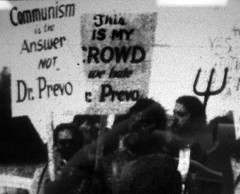
  4. Prevo's devil men

    Prevo's devil men

  5. The devil costume debacle illustrates Prevo’s self-obsession. Despite numerous evidences that Anchorage residents in general, & the protesters in particular, were truly concerned about the situation in South Africa, to Prevo it was all about him.  There wasn’t even a word to be heard about the guy he’s ostensibly working for.  The signs he had his devil men carry were all about “Dr. Prevo, Dr. Prevo, Dr. Prevo.”  Where was Jesus in all this? Maybe at that other church over there. Betcha Dick Madden talked about Jesus in his sermon that day.
  6. Communism isn’t the answer.  Neither is Dr. Prevo.

Devils can wear masks, too

The devil wears a mask

The Devil wears a Mask. Photograph by corazón girl; used under a Creative Commons license.

References

  1. Butterfield, Fox. (12 Feb 1987). “Trustee’s remark renews charges of racial insensitivity at Wellesley.” New York Times, p. A-20.
  2. Pear, Robert. (21 Aug 1985). “Falwell denounced Tutu as a ‘phony’.” New York Times, p. A3.
  3. Gadberry, Greg. (26 Aug 1985). “Marchers aim wrath at Prevo: Foes of apartheid picket Baptist temple.” Anchorage Daily News, pp. A1, A12.
  4. Associated Press. (25 Aug 1985). “South Africa seizes 27 anti-apartheid leaders.” Anchorage Times.
  5. Cowell, Alan [New York Times]. (25 Aug 1985). “Apartheid dictates tale of two cities.” Anchorage Daily News, p. E1.
  6. Robin, Karen. (26 Aug 1985). “Prevo explains South African views.” Anchorage Times, p. B1.
  7. South Africa Truth and Reconciliation Committee, Amnesty Committee. (1999). “Decision – Khotso House Incident.” (AC/99/0242).
  8. Braid, Mary. (30 Oct 1998). “Truth And Reconciliation Commission: Report lays blame at Botha’s door.” The Independent.
  9. Cowell, Alan. (29 Sep 1985). “A day in the uneasy life of Soweto’s black mayor.” New York Times, p. 14.
  10. Toomey, Sheila. (8 Oct 1985). “‘Devils’ approved by Prevo.” Anchorage Daily News, pp. A1, A14.
  11. United Press International. (26 Aug 1985). “Poll shows South African blacks support sanctions.” Anchorage Daily News, p. A12.

Posted in Alaska politics, Ordinance, The incredibly true adventures of Rev. Jerry Prevo | Tagged , , , , | 14 Comments

Rial Eugene Green, 1919–2009

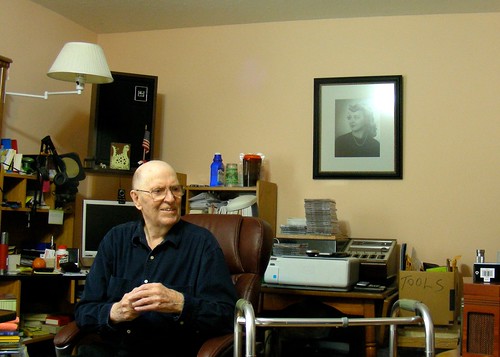
Dad

Posted in Greens | Tagged , | 1 Comment

Prop 8 again

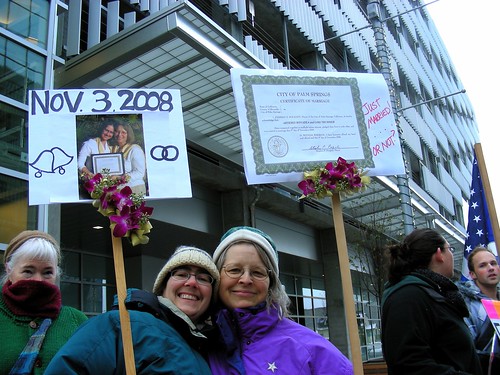
Artemis & Lori: married Nov. 3, 2008 in Palm Spring, CA: marriage still valid

Artemis & Lori: married Nov. 3, 2008 in Palm Springs, CA: marriage still valid

A few months ago, a slim majority of California passed Proposition 8, which banned same-sex marriage in California after five or six months of it being legal.  Since then, we’ve been waiting for the California Supreme Court to decide upon the measure’s legality under the California constitution.

Today, by a vote of 6 to 1, the justices upheld it.

Protesting for marriage equality

Protesting for marriage equality

I can’t say I’m surprised.  Nor, however, am I particularly demoralized: I think we’ve already begun seeing a sea change. Massachusetts, Connecticut, Iowa, Vermont, Maine… New Hampshire is close, New York not far behind. Things are starting to go the other way. And younger voters overall favor equal rights, while older voters who don’t are gradually dying away.  As one person commented in one of my online communities,

This will be a pyrrhic victory [for opponents of marriage equality]. The 20-somethings are for gay marriage by a 3-1 or more margin. You’ll see a reversal on Prop 8 within 5 years with a 55-45 vote at least. It is a lot better when it happens through the political process than from the courts (e.g. abortion). I realize this is no solace for those who have to wait.

I couldn’t have said it better myself. And note that the later states in which same-sex marriage is being established are all establishing it through the political process.

Protesting for marriage equality, 26 May 2009

Protesting for marriage equality, 26 May 2009

Meantime, it was of some comfort that the 18,000 same-sex marriages that took place in California during the brief period of marriage equality were ruled, in the same decision by the California Supreme Court, to be valid.  It delighted me to know that Artemis & Lori, whom I met last November during an Anchorage protest of Prop 8, just a few days after their wedding in Palm Springs, California, are still recognized as having a valid marriage — at least, in California.

After work today, I bussed downtown to join the small protest of the California Supreme Court’s decision.  Like the one last November, this one was held at the Atwood Building in downtown Anchorage.  It was organized more or less at the last minute, so there were only a few people present — a total of seven during the time I was there, before I had to get home to take care of the dog.  But it was good to be there anyway, & to get at least a few honks from supportive passers-by.

Related:

Posted in Marriage equality | Tagged , | Comments Off on Prop 8 again

Found & lost

I don’t know if I will ever again live with or love somebody, other than the somebodys that have always been my cats.  And you know, even though any person you love & live with has their weirdnesses, as I have mine… even though there are frustrations, & stuff you gotta put up with — you love them just the same.  You love them, & you miss them when they’re gone, the frustrating stuff as much as the wonderful stuff that you can get nowhere else.  And now that it’s gone… well, it’s good to cry about it like I do.  That I cry, that the loss makes me sad, that I feel something not nothing, for something that will always mean so much to me in the loss of it, as it was in the finding of it.

Posted in Journal | Tagged , , | Comments Off on Found & lost

Blinks

On Facebook, my friend David has been thinking about blinks.  He posted a brief little meditation about it a few days ago, & this morning a wonderful short poem called “Blinking” that I wish I could post here but I haven’t asked him so I won’t.  😉 But his poem led me to dig up a nonfiction piece I wrote many years ago, 1994, in an undergrad nonfiction workshop taught by Gretchen Legler at University of Alaska Anchorage.  It’s about memory.

At the time of writing, my partner Rozz and I were early in our relationship, & had lived for about a year together in a small rented house in the Mountain View neighborhood of Anchorage — the first place we shared.  My mom was still alive, & my parents still lived in the same house in Columbia Falls, Montana where I grew up.  I still had my cats Lemminkäinen (Lem for short) & Eight Lives, & Rozz still had her dog Whylie.  A lot has changed since then.  Which makes the blinks described here, both of 1962 (or whenever) & 1994, all the more precious.

Blinks

I lie in a bed, warm.  It’s my parents’ bed.  I lie on my left side with my back to whoever lies in the bed with me.  It might be my mom, or maybe it’s my dad.  Maybe it’s both.  But I can’t see them because they are behind me.  The room is dark, but the door is open and light spills in from the next room.  I hear voices from the next room, and feet, stamping.  It’s my brothers, getting ready for school.  Outside, I know, it’s raining.

This is my first memory, lying in my parents’ bed, warm, aware of other people’s presence — the weight of my mother or father behind me on the mattress, my brother’s voices — but seeing no one, seeing nothing but the dark room and the light coming from the next room.  It’s as though I blinked into existence merely to collect this memory, and blinked out again once I’d retrieved it.

But I blink in equipped with some knowledge, for while there’s a lot I don’t know, there are some things I do.  That I have brothers, for instance.  I don’t see them, and while I hear their voices, they are blurry, indistinct, unsexed.  I don’t know their names.  But I know it’s them and I know they’re getting ready for school.

What is school?  In my memory it’s merely a word to describe a place they go when they’re not here, where I am.  And where is that?  In my parents’ bed, but I’m not sure which house.  I want to say it’s the big two-story house where my parents still live, but that may be only because it’s the only house I remember in detail.  But my parents have told me we lived in a different house for the first few years after I was born, so it could be my first memory takes place in a room of that house.  But they’ve pointed that house out to me — I’m certain it had only one floor.  Yet I can’t hear the rain — surely in a one-story house I would hear the rain hitting the roof.  So I must be in the big house, I must be in my parent’s bedroom where I slept in a crib till I was five, because there weren’t enough bedrooms to go around, because my dad hadn’t yet built the bedrooms in the attic.

But why am I in my parent’s bed, not in my crib?  Maybe I was crying in my sleep and Mom or Dad came and got me to comfort me, and my blinking into this scene was my waking up.  But no, there’s no sense of sadness or discomfort as I lie there, nothing to indicate I was, or had been, distressed.  Maybe one of my parents got me up for the day, brought me out of the bedroom for breakfast, or to the bathroom — surely I’m out of diapers by now — and when I got done, I found my other parent still in bed and jumped in, wanting to cuddle.  Yes — and that would explain how I know it’s raining — I’ve been about in the house, I’ve seen the rain out the window.

I feel like a detective.  Why am I aware of my brothers and not my sister?  She was born before me — she must be around somewhere.  In my early childhood she and my brothers shared the bedroom next to our parents’ room.  She slept in an old-fashioned trundle bed, a little bed on casters that was rolled under my brothers’ bunk beds during the day.  Maybe I’m not aware of her because she’s not getting ready for school.  Maybe she doesn’t go to school yet.  And if that’s so . . . I can learn how old I am.  Mer is just a year younger than Mark, so if he’s going to school and she isn’t, he must be in first grade.  That would make him 6 years old, and Mer 5.  Dave would be 10.  And I would be 3.  It would be 1962, a rainy fall day, far away in Montana where my parents still live, in the house they still live in, in the room that long ago, after Dad built the upstairs bedrooms, turned into the “sewing” room, then the “utility” room, then finally — more honestly — the “junk” room.

But in 1962 it was the bedroom, my parents’ and mine, and I lie on my left side seeing the dark of the room and the light of the next room and hearing the voices and feeling . . . how?  Not distressed, that’s been established.  But I don’t feel ecstatic, either, not transcendent or joyful or anything one would consider so remarkable as to pop me into existence to experience that moment.  I just feel . . . okay.  Warm.  Comfortable.  Dry.  Secure.  Like so many moments of my life it’s a moment I imagine someone outside myself would find endlessly dull and prosaic, but to me it’s fascinating, something I return to.

As I will return to this morning.  Rozz has already gotten up, gotten dressed, made breakfast, made lunch, and written some in her journal.  Now she comes in to snuggle with me for a few minutes where I lie on my right side, facing toward the window with its venetian blinds, my right hand tucked under Lem’s warm purring belly.  My other boy, Eight Lives, regard me with benevolence from atop my left shoulder.  Probably he’s purring, too.  Rozz is behind me, her left arm thrown over my waist, her breath in my hair.  Whylie, her dog, is probably behind her somewhere, on the other side of the bed.

I know it’s raining outside because I can hear it — we live in a one-story house.  I feel wonderful and lazy, except I know in a minute Rozz will tell me what time it is.  Then she’ll get up and take Whylie out for a quick walk, and I’ll have to get up and get dressed and put on my shoes and wash my hair and comb it and be ready, by the time Rozz gets back with Whylie, to drive us both to work.  I’m not so lucky as the little girl of 32 years ago, who gets to lay about warm and sleepy while others go out to the work of the world.  But until it blinks out, there is this moment.

[October 6, 1994]

Posted in Greens, Nonfiction | Tagged , , , , , , , , , , , , , , , , , , , , , , , | Comments Off on Blinks

Prevo's red herrings

Support Equality Works!

Support Equality Works!

Early in his ministry, Jesus, walking along the shoreline of the Sea of Galilee, saw the brothers Simon Peter and Andrew at their work as fishermen and said to them, “Follow me, and I will make you fishers of men” (Matt. 4:19, KJV).

There’s no doubt that Jerry Prevo has followed the in the footsteps of these earliest of Jesus’ disciples, coming to Anchorage in 1971 as pastor of the Baptist Bible Church (average attendance 300), and building it into what is now one of Alaska’s largest churches, the Anchorage Baptist Temple (average attendance 2200). On top of that, he’s the CEO of two Christian radio stations and a Christian TV station, has a daily radio program, and his Sunday services are broadcast and rebroadcast daily as well. [See references 1 & 2 for sources.] A fisher of men indeed.

But evidence suggests that Rev. Prevo also excels as a fisher of red herrings.

Now, I like fish. I eat it a lot. Salmon, sardines, kippers — nice, fishy, oily coldwater fish, healthily high in your essential omega-3 fatty acids. And tasty, too, at least if you like nice, fishy, oily coldwater fish, as I do. My friend Marcia doesn’t, so if i cook fish when she comes over we have tilapia, a mild white-fleshed fish that doesn’t, she says, taste or smell “fishy.”

Kipper

Kipper

But I mentioned kippers: some people don’t know what those are. As described by Michael Quinion of World Wide Words, kippers are “herrings that have been split, salted, dried and smoked” — a method of preparation that helped preserve fish for market in the days before refrigeration and rapid transportation.[3] Nowadays, one can also buy kippers in a can, like sardines.

Canned kippers

Canned kippers

Quinion goes on to explain a method of preserving herring for even longer than kippers will keep:

Red herrings are a type of kipper that have been much more heavily smoked, for up to 10 days, until they have been part-cooked and have gone a reddish-brown colour. They also have a strong smell. They would keep for months (they were transported in barrels to provide protein on long sea voyages) but in this state they were inedible and had to be soaked to soften them and remove the salt before they could be heated and served. [Ref. 3]

It’s this kind of herring from which comes the term for the kind of red herring for which Rev. Prevo has recently been fishing so fervently and with such monumental success. Known in rhetoric by the Latin name ignoratio elenchi (“ignorance of refutation”) or by the alternative English name the irrelevant thesis, the red herring is the most general and common of the fallacies of irrelevance: an argument in which the premise bears no logical relationship to the conclusion. [Ref. 4] Quinion relates that most etymologies he consulted state that red herring became the metaphor for this kind of logical fallacy because it was believed that the very smelly fish was sometimes dragged across the ground — for example, by escaped convicts — to confuse the scent being followed by tracking hounds. Quinion gives strong evidence for a different etymology. But regardless of etymology, its meaning in English usage — an argument which distracts people from the real issues involved — remains. [Ref. 3]

And a smellier, more inedible batch of red herrings it would be hard to find that could compare with those found in Rev. Prevo’s recent arguments against the equal rights ordinance proposed last week in the Anchorage Assembly.

If passed, the ordinance would prohibit discrimination in employment, housing, financial practices, public accommodations, and education on the basis of “sexual orientation: and “veteran status”, thereby adding these two classes to those already included under Title 5, Anchorage’s equal rights code: race, color, sex, religion, national origin, marital status, age, and physical or mental disability. [Ref. 5]

There are a number of red herrings that Rev. Prevo has brought up already in opposition to this proposed ordinance, but to cover them all would make for a very long post indeed from someone who already writes pretty long posts.  So let me focus here on the red herring at the heart of Rev. Prevo’s current set of arguments:

Red herring

The legal term sexual orientation

Rev. Prevo has a long history of opposing equal protection under the law for lesbians, gay men, and bisexuals. He was a prominent opponent of two antidiscrimination measures in Anchorage in 1975 and 1992-1993; the main difference this time around is the current proposal’s inclusion of  actual or perceived “gender expression” and “gender identity” within the proposed ordinance’s definition of sexual orientation, which also includes actual or perceived heterosexuality, homosexuality, or bisexuality.

On Friday, May 15, 2009, Rev. Prevo faxed a letter, addressed to community leaders, to an unknown number of people.  [Ref. 6] Chief among the red herrings thrown up in the letter are Rev. Prevo’s statements regarding, as he phrases it, the “legal term ‘sexual orientation’.” For example, from page 5 of his 7-page letter (not including the fax cover page):

“Sexual orientation” is a wildly expansive term that can encompass virtually any sexual temptation known to man. (See the definition in the proposed Anchorage Ordinance). If “sexual orientation” is added to the Anchorage’s nondiscrimination code, it will provide instant legal special rights to any kind of sexual behavior, no matter how perverse. [Ref. 6]

(The “special rights” argument is another of the false arguments frequently brought up by Rev. Prevo and other opponents of equal rights for LGBT people.)

Rev. Prevo goes on in a lengthy appendix to summarize a number of sexual practices described in the Diagnostic and Statistical Manual of Mental Disorders, 4th edition — also known as DSM-IV, the diagnostic “bible” of the American Psychiatric Association — thus implying that somehow the ordinance, if passed, would provide “legal special rights” to all the practices described in DSM-IV — including pedophilia (sex with children), necrophilia (sex with corpses), and zoophilia (sex with animals, also known as bestiality). [Ref. 6]

Never mind that DMS-IV is a diagnostic manual, not a manual of legal terminology.

Never mind that many of the practices — and certainly pedophilia (sexual abuse of minors) and necrophilia — are prohibited by Alaska statute and federal law, which no municipal ordinance is going to trump.  (Sexual abuse of minors is a crime at four different degrees under Alaska Statutes ranging from felony to Class A misdemeanor level. [Refs. 7–10] Necrophilia is a Class A misdemeanor under AS 11.61.130, “Misconduct involving a corpse.”  [Ref. 11] Zoophilia, not explicitly forbidden in Alaska law, does not appear to be covered by existing animal cruelty statutes. House Bill 6, under consideration in the Alaska Legislature, would explicitly make sexual conduct with animals a Class A misdemeanor. It’s already passed the Alaska House. [Refs. 12–14])

There is also simple fact that Rev. Prevo’s red herring obscures common legal definitions of the term sexual orientation, and (in spite of his instruction to read it) specifically ignores the definition contained in the ordinance being considered by the Anchorage Assembly.

Here, in fact, is the definition of sexual orientation found in the proposed ordinance (which can be read in full here, in PDF format):

Sexual orientation means actual or perceived heterosexuality, homosexuality, bisexuality or gender expression or identity. As used in this definition, “gender expression or identity” means having or being perceived as having a self-image, appearance, or behavior different from that traditionally associated with the sex assigned to that person at birth. [Ref. 5]

Keep this in mind as you read through his letter. If Rev. Prevo is not telling the truth about the legal meaning of sexual orientation — what else is he not telling the truth about?

Read the proposed ordinance here
or at the Assembly’s website.

Read Jerry Prevo’s May 15 letter here
(includes an introduction about his
“definition of sexual orientation” red herring).

References:

  1. Anchorage Baptist Temple. (n.d.) “About Our Pastor.” At Anchorage Baptist Temple website. Retrieved 21 May 2009.
  2. Anchorage Baptist Temple. (n.d.) “Church History.” At Anchorage Baptist Temple website. Retrieved 21 May 2009.
  3. Quinion, Michael. (25 Oct 2008). “The Lure of the Red Herring.” At World Wide Words (website). Retrieved 21 May 2009.
  4. Curtis, Gary N. (n.d.) “Red Herring.” At Fallacy Files (website). Retrieved 21 May 2009.
  5. AO 2009-64, “An ordinance of the Anchorage Municipal Assembly amending Anchorage Code Chapters 5.10 Equal Rights Commission and 5.20 Unlawful Discriminatory Practices.” Draft pepared for reading May 12, 2009. Anchorage Municipal Assembly, Anchorage, AK.
  6. Prevo, Jerry. (15 May 2009). Faxed letter addressed to Anchorage community leaders. Includes introduction on “Jerry Prevo’s Red Herrings” by Melissa S. Green, 22 May 2009.
  7. AS 11.41.434, “Sexual abuse of a minor in the first degree.” Alaska State Legislature Textual Infobases, 2008 Alaska Statutes.
  8. AS 11.41.436, “Sexual abuse of a minor in the second degree.” Alaska State Legislature Textual Infobases, 2008 Alaska Statutes.
  9. AS 11.41.438, “Sexual abuse of a minor in the third degree.” Alaska State Legislature Textual Infobases, 2008 Alaska Statutes.
  10. AS 11.41.440, “Sexual abuse of a minor in the fourth degree.” Alaska State Legislature Textual Infobases, 2008 Alaska Statutes.
  11. AS 11.61.130. “Misconduct involving a corpse.” Alaska State Legislature Textual Infobases, 2008 Alaska Statutes.
  12. House Bill 6, “”An Act relating to proscribing certain sexual conduct or sexual activities as cruelty to animals.” Bill History/Action for 26th Legislature. Alaska State Legislature. Retrieved 22 May 2009.
  13. Lynn, Rep. Bob. (26 Feb 2009). “House Bill 6: Cruelty To Animals” (sponsor statement). The House Majority (website). Retrieved 22 May 2009.
  14. Sutton, Anne. (21 Mar 2009). “Alaska and Florida Consider Bans on Bestiality.” The Huffington Post. Retrieved 22 May 2009.
Posted in Alaska politics, Ordinance, The incredibly true adventures of Rev. Jerry Prevo | Tagged , , , , , , | 3 Comments

Religion v. belief

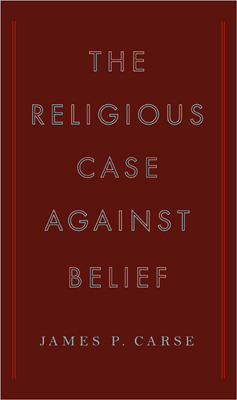
The Religious Case Against Belief by James P. Carse

The Religious Case Against Belief by James P. Carse (New York: Penguin, 2008)

Friday before last, on my way down for coffee, I spotted a book on the new books shelf of the UAA/APU Consortium Library whose title caught my interest: The Religious Case Against Belief.  Its author, James P. Carse, is a professor emeritus of religion at New York University, where he spent 30 years directing its religious studies program.

I checked it out & spent a good part of the next morning waiting for my tire changeover at Johnson Tires & fighting my muzziness (I’d been up into the early morning hours finishing my post on same-sex marriage) to read it, & actually getting a lot out of it despite my sleepiness.

Later in the day, a friend of mine came to visited my blog & made a comment on a post I’d written way back in 2006 called “The god thing.” It was interesting coincidence — or perhaps, as I said in my reply to her comment, “perhaps the intervention of Dice the spirit of luck, or so I call her in my eternally forthcoming novel Mistress of Woodland” — that my friend should find that post to comment on just when I’d found this book, which in part discusses what I was saying in that post, and in part what my friend was critical of in organized religion. As she stated:

I don’t believe in any religion on the planet. (Jim Jones and his mass murder/suicide of men, women and children Guyana in 1975 was my wake-up call.) As far as I’m concerned, if the leader has a human body/mind that person can be wrong, wrong wrong…about anything. No flipping way I’m going to follow them.

So far, I’ve found in Carse a pretty good explication of what turns both my friend & I away from organized religion.  My main difficulty (at least on the muzzy, sleep-deprived mind I had last Saturday) is that Carse uses terminology in a way that is unfamiliar to me (despite my B.A. in Religion): e.g., he uses the terms religion where I would more likely use the terms spirituality, & belief or belief system where I would more likely say organized religion or religious ideology.

But same diff.  By Carse’s light, belief system is the kind of horror we’re used to having to put up with from the hardcore “true believer” types who’d like to kill people for differing with them, & who are so hardwire-tied to their belief systems that they’d die for them.  And they do both.

It’s this kind of ideological attachment to belief systems — to religious & other putatively all-explaining ideologies, which claim to have all the answers, & to hold the blueprints of the heavens, as it were— that are responsible for most of the wars in the world. And those belief systems are not, by Carse’s light, truly religion, because true religion does not presume to hold all the answers; true religions recognizes the unknowable.  Carse is, in essence, calling for religion to toss out the belief systems — the ideologies that are the true destructive forces which lead people into violence, murder, war.

And now that I’m getting accustomed to his terminology, I’m in full agreement with him.

As I wrote in my post “The god thing”

Any time science learns how to “explain,” answers a question, it gives rise to umpteen further question: there is no end to them because we, just tiny motes of what-god-is, can’t fit any more into our understanding than what we can fit into our thoughts, our speech, our books. As my calculus tutor used to explain, no system can contain a metasystem. No matter how much we understand, there will always be Mystery beyond that. Which is why, I think, people who are wise are also people with humility: however much they know, they are aware how very little that really is.

Somehow, for me, using that word god keeps me mindful about all that. But I don’t think one must use that word to be conscious of it.

As I wrote in my poem “Sermon”

God cannot be enclosed in a book
or in the miser’s soul
which portions out justice in dribbles
and rations out love in crumbs,
then wonders why we starve.

I’m still reading this book. I’m finding Carse’s analysis very useful for looking at some of the bad stuff going on in the world, both in the larger world of international politics — Israel & Palestine, Iraq, the “War on Terror” — & in the world closer to home, as our local “true believers” continue to wield the weapon of their willful ignorance, willful misuse of language, & false witness to maintain an unjust status quo.

Posted in No Way Way | Tagged , , , , , | Comments Off on Religion v. belief

Working on the website

Taking some time out from blogging about the Anchorage equal rights ordinance, or about anything else for that matter, to work some on the website.  Used to be I had a website under the .nu domain, as well as some blogs at blogger.com — still do, actually, but all their content has already or will be moving here (& I’ll be aiming the domain Henkimaa.nu to come here too, once that content is moved), but I’m still in the process of organizing the website to be how I want it to look.

For the technically curious, I’m using WordPress for the main guts of this site; but I plan to use some of the other bells & whistles available at my (fairly new) webhost (Bluehost.com) too. At the moment I’m figuring out what WordPress theme I want to use & how to customize it, so there’s gonna be a bit of morphing of appearance for the next little bit until I get it put together to my satisfaction.

For the content curious, despite my focus over the last few days on the Anchorage equal rights ordinance & LGBT political rights, I’m not primarily a political or even an LGBT political blogger.  But y’know, I’m doing enough of it that I’ll face reality & make that a main category of the blog.  Mainly, however, I am a writer/poet: hence the category Field of Words.  I also blog a lot about health, especially relating to insulin resistance, prediabetes, & diabetes prevention: hence the category Terveys, which is the Finnish word for health.  I also have a B.A. in Religion (Wellesley College, 1981), & continue to have an interest in religion & spirituality, not to mention my own little self-invented belief system, hence the category No Way Way.  The category Itse (Finnish for self) is for more personal day-do-day stuff, or a catch-all for other subject matter.  Other categories will come clear in time. (For example, Finndex, which will be for all things Finnish.  That I write about, anyway.)

But now: back to work.

Posted in Meta | Tagged , | Comments Off on Working on the website

Sermon (a poem)

It’s Sunday, a day of sermons. Tales have it that Rev. Jerry Prevo will be delivering one of his predictable diatribes against homosexuality from his pulpit at the Anchorage Baptist Temple (broadcast live at 11:00 AM on KCFT-TV — cable channel 19, broadcast channel 35). In counterpoint, this week’s sermon at 2:00 PM at MCC Anchorage will be on “Homosexuality, Christianity & the Clobber Scriptures” used by conservative Christian churches (like ABT) to promote anti-gay messages. I heard yesterday that the Rev. Howard Bess, a longtime ally of LGBT Alaskans & author of Pastor, I Am Gay, will be delivering a guest sermon at Immanuel Presbyterian Church.

My own sermon is below — a poem written in December 1992 in response to the hatred & bigotry propounded by Rev. Prevo & like-minded preachers during the 1992-1993 battle inside and outside the Anchorage Assembly chambers over the same issue facing us today: whether lesbians, gay men, bisexuals, and transfolk in Anchorage will be afforded equal protection under the law from discrimination on the basis of a fundamental part of our fabric as human beings: our sexual orientations and gender identities.

(With thanks to Stephen Mitchell, whose translation of The Book of Job helped me to find the words.)

Sermon

I

I take as my text the Book of Job —
for are we not like him, innocent,
suffering, crying out for justice?
are we not like him, each of us
surrounded by these righteous,
these pious friends who so love us,
who console us with false accusations,
who comfort us with lies?

Hear them — Eliphaz, Bildad, Zophar —
High in their pulpits they proclaim the good news:

Admit your guilt and repent your sin
the merciful Lord God will welcome you in.

What’s your complaint? you got fired from your job?
The good Lord will cast you to fires of damnation.
Your landlord has served you notice of eviction?
The Lord will evict you from heavens’s salvation.
Beat to death in the street? God signed the death warrant.
Infected with AIDS? The Almighty’s decree.
Discrimination — if it happens, which we won’t admit —
is admonishment of your culpability.
God in his compassion has served you fair warning
and if God’s indisposed, well, we’re God’s grand jury.

But admit your guilt and repent your sin
the merciful Lord God will welcome you in.

We’re a large church, but we’re a friendly church.

II

Is there anything so innocent
as the child you were at birth?
tiny and wrinkled
from between your mother’s legs
you cried — I am here! I am alive! —
such was your first yell — joy of birth!

Were you a sinner then?
Was it sin to cry for your mother’s breasts?
were you damned by your desire
for the warmth of your father’s arms?

Years grew you.
Your ears heard the lessons
of your elders who taught you
the rules to live by:
how you took them to heart.
How you chastised yourself
when you stepped out of bounds
in body, in mind.
How you took them to heart

as alone in your bed
you lay in the quiet.
You stared at your fear,
your eyes searched the night.
Your mind search your soul —

evidence — why
examination — am I
condemnation — vilify
queer — cry

— such were your tears, pressed into your pillow.
Such were your muffled sobs — grief of damnation

III

Be honest — which of you chose it?
Which of you when first you learned
you were queer — faggot! lezzie! homo!
accepted that label with joy — celebration?

Which of you did not deny it?
Which of us did not seek to hide it?
Some hide it still — some are yet there.
Who knows silence better than we?
How we take it to heart.

Searching, seeking the root of our anguish —
how many of our sisters, our brothers
swallowed some pills, or took a mighty leap
to lie broken and crushed on the pavement?
How many of us climbed into a bottle
or crucified ourselves on a needle
or lost ourselves in an endless tangle
with the bodies of others such as we?
ecstasy! of orgasm — but after,
as we lay together side by side
in the tangle of sheets we wrestled amongst —
we wrestled alone with our dread
in the silent prisons of each heart, each head.

IV

But listen: you’ve heard of the patience of Job?
He was not so patient. Nor should we be.

How many of us looked to heaven to plead —
to shout — which of us demanded —

Yo, God!
Who’dja make the bet with this time?
Some bet. A sure thing.

Do you get your omnipotent jollies
from fate — create a creature
who by nature is unable
to adhere to your commands
without lying, without denying
what you created us to be?
I must abandon my integrity
or you abandon me?
Do you laugh to see us wriggle
with predestined misery?
Who then is righteous, who the sinner,
oh Lord God Almighty?

If this be heresy, if I blaspheme,
then teach a clear lesson, Lord God Supreme.
Cut short the suspense. Loose your thunderbolt.
Fry me where I stand and end my revolt.

Till then, this gospel I give:
curse God — and live.

V

But no — we curse not God,
but this false image of God they’ve made:
a warped, twisted abridgment

stuffed into a book, a Sunday sermon,
their cramped and distorted souls.

Can God be contracted —
compressed — compacted —
and still be God? Can you
hold in the palm of your hand
the width of the cold winter sky? Can you
forge the evening star into a ring
to adorn your little finger? Can you
play the harp of the northern lights? —
each touch of God’s fingers recolors the strings
in hues none of us has imagined.
Can you hide the summer sun
under a bushel basket? — Listen:
blind can lead blind, but the sun will still shine.

God cannot be enclosed in a book
or in the miser’s soul
which portions out justice in dribbles
and rations out love in crumbs,
then wonders why we starve.

God is too wide and vast and long
and knows us for what we are
as is known the sky, the river, the rocks,
as is knows each creature that breathes.

God is too wide, too vast, too long
and knows us as we are.

[December 29, 1992]

Posted in Alaska politics, No Way Way, Ordinance, Poems | Tagged , , , , , , , , , , , , , | 3 Comments