
This was our car this morning, before I drove to work. No complaints really: this is Alaska, after all, & we usually have snow this late. Besides, I hear they’re getting big snowstorms in the Lower 48.

This was our car this morning, before I drove to work. No complaints really: this is Alaska, after all, & we usually have snow this late. Besides, I hear they’re getting big snowstorms in the Lower 48.
Just because it’s March 20 is no guarantee that spring is just around the corner. We got a big buncha snow, maybe three or four inches, yesterday & this morning. But Sweetheart took it well when I took her out in the backyard this morning for her morning doo-doo-duty.
Study casts doubt on ‘good carb’ diets
Following glycemic index not effective in controlling blood sugar
The Associated Press
Updated: 2:20 p.m. ET March 6, 2006COLUMBIA, S.C. – Diets that distinguish between “good carbs” and “bad carbs,” are not an effective way of controlling blood sugar levels, a new study suggests.
But read a bit closer & there are plenty of problems with this study that even just an alert layperson like me can spot.
The new study, published in the February issue of the British Journal of Nutrition, relied on food questionnaires from more than 1,000 people over five years and assessed their consumption of high- and low-glycemic foods.
Food questionnaires are a notoriously unreliable way to get information about what people really eat. People forget. People lie. People eat craploads of refined foods which are almost by definition high-glycemic, It would be far more accurate to get them to keep actual day-by-day food diaries & to check their blood glucose frequently. But that would be too much work & cost too much.
Let’s not forget either that people are doing the assessment of the glycemic levels of the foods that these 1,000+ people wrote down in their food questionnaires: the foods they actually ate were not tested. This introduces at least two problems: (1) all kinds of biases can be introduced in the assessment process; and (2) it is extremely difficult to assess the glycemic index of an untested food.
Researchers tested their blood sugar levels twice during the study period and found no significant correlation between the glycemic index of foods and the blood-sugar levels of participants.
Twice?!!!! They checked them twice?!!!!!
What time of day: in the morning before eating? After a meal, & at what time? After how long a period of time? Geez — a well-controlled diabetic will test her or his blood glucose far more often than that over a five year period!
Let’s also not forget that there are all kinds of additional factors that can affect an individual’s blood glucose. How much stress in their lives, what time of day & how close to a meal their blood was tested, what other health concerns do they have, how much sleep do they get, to name just a few. Were any of these factors controlled for?
I’m not a scientist, but I am an intelligent person who has read quite a helluva lot about GI & blood glucose control since I started on this path in late December. From the details given in the article, I’d say this study’s methodology laughably poor, & its conclusions, at best, inconclusive.
Mayer-Davis said that researchers should develop a new measure of how different carbohydrates can affect health. She said a better index would be based on the physical characteristics of foods, such as fat content and calories, because numerous factors influence a food’s effect on blood-sugar levels.
Of course GI all by its lonesome is not the only factor that will affect blood glucose control. The GI people themselves say that, & say it often. But there is no doubt that paying attention to GI has significant benefits for the blood glucose control of people who are insulin resistant or fully diabetic — as has been demonstrated by numerous studies better-designed than this one appears to have been.
And on the purely anecdotal level, there’s what it’s doing for me.
The March issue of the Glycemic Index Newsletter, put out by the good folks at U. Sydney, is out.
Among other interesting news:
There are also a low GI recipe of the month, announcements of a couple new GI books, & answers to some frequently asked questions, including about rice & hypoglycemia. And of course you can also read the archives with past issues of the GI newsletter.
For those who don’t know about it, the GI newsletter is also available as an RSS feed, which means that if you subscribe to any feeds from blogs, newspapers, etc. so that you get stories as they come out, you can do it with the GI newsletter too. I used a free web-based service called Bloglines to manage my subscriptions; there are others out there too.
Among other feeds I subscribe to: David Mendosa’s diabetes blog . Today he posted an article about “the Carbohydrate Controversy,” contrasting the traditional American Diabetes Association high carb diet with Dr. Bernstein’s low carb recommendations. He also discusses the glycemic index, which the ADA is beginning to grudgingly accept as possibly perhaps maybe having some benefit. (About time!) Mendosa doesn’t really come down on one side or the other of ADA vs. Bernstein, but he’s been a GI supporter for a long time.
After much thought, I’ve returned to my daily dancing, on the reasoning that (1) I missed it like crazy; (2) I can’t find anything despite looking very hard to back up Schwarzbein’s assertion that more than 20 minutes twice weekly of aerobic exercise amounts to overexcercising for someone in my metabolic state; & (3) Schwarzbein is an endocrinologist, not an exercise physiologist.
So unless/until I can find some confirmation for her assertion, including my own experience if I’m wrong right now, I’m back to my daily aerobic workout, along with weight training & flexibility training.
The name of this post is, by the way, a quote attributed to Emma Goldman (but is more likely a paraphrase of something she said than a direct quote).
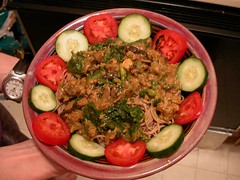
Rozz put this together for dinner tonight — mmmmmm good. This is organic ground turkey with kale, a bunch of spices including curry, on soba noodles made with buckwheat & yam. With tomatoes & cucumbers to the side, of course. And bless her, she made enough I can take some for lunch tomorrow too.
On January 27, I wrote a post called “State of my art” (based on a post I wrote to the list LowGlycemicEating@yahoogroups.com) which detailed where I was at on matters dietary at that time. A few weeks later, I’ve added to my store of knowledge & advanced, at least somewhat, the state of my art. Here was my answer earlier today to a list member recently diagnosed with diabetes who asked what kind of foods she should eat. It especially reflects my changed attitudes about amounts of carbs & fats (the healthy kinds, of course) I should eat after having read the Schwarzbein Principle books (see “Eating to heal insulin resistance” on 5 February).
Hi my name is ____. I am new to the group and just found out I am a diabetic I know about eating protein and vegetables and nuts and seeds. Is there anything else that I can eat that won’t bring my sugar up?Hi, ____, welcome to the group. I’m prediabetic myself, & working through diet & exercise to increase my insulin sensitivity & hopefully to prevent myself from getting diabetes. Since starting my permanent lifestyle changes (dietary & physical activity), I’ve become convinced that most Type II diabetics & those like myself at high risk for diabetes can greatly increase their insulin sensitivity & hence improve their blood glucose regulation with little or no resort to diabetic medications — IF they are willing to make the necessary permanent changes in their dietary habits & levels of physical activity.
For foods you can eat — begin with low glycemic index carbs, of course! It is really important to learn what you can about what carbohydrates are low or moderate GI & which you should avoid because they’re high GI. In particular, avoid refined products, such as anything made of white or enriched flours. (“Enriched” just means they’ve stripped out a lot of the nutrition & then done an inadequate job of adding them back in again.) Instead, use whole grains. White potatoes are also high GI; instead use sweet potatoes or yams. Also watch your portions of any carbs, even those that are low GI.
I have come around to believing that at least to begin with, anyone who is insulin resistant who is trying to heal their metabolism shouldn’t eat any more than around 100 grams per day of carbohydrates (other than dietary fiber), spaced out in at least five meals/snacks at least two to three hours apart. This might be different depending on your metabolic status & your physical size (tall, short, etc.) — but check your blood glucose to see what works & what doesn’t.
Spacing out your carbohydrates in smaller, more frequent meals will help keep your blood glucose (& also your insulin levels) at a more consistent level, instead of it roller-coastering up to huge spikes & low hypoglycemic nadirs.
Always eat carbohydrates with other foods: protein, healthy fats, non-starchy vegetables. Every meal. Every snack too: at least always have a protein with any carbohydrate. Never ever ever eat a carbohydrate all by itself, unless you are going to exercise immediately afterward. (Exercise helps to move glucose into body cells, even when you are insulin resistant.)
I’d add —
Healthy fats, such as those containing the Omega-3 fatty acids. Good sources include flax seed or flax seed oil, cold water fish such as salmon, cod, tuna, herring (including kippered herring), sardines. Omega 3s are often added to other foods too like eggs.
Cinnamon — research has found that even as little as 1/2 tsp. to a tsp. a day can increase insulin sensitivity.
Greens — like spinach, romaine lettuce, kale, collard greens, dandelion greens, etc. In fact, you should eat a full spectrum of colors (green, orange, red, yellow, purple, etc.) in your foods — there are lots of good vitamins, minerals, etc. in these that are beneficial to the insulin resistant person.
Fiber — both (water) soluble & insoluble dietary fiber, found in fruits, vegetables, grains, etc.
Those are what pop into my head. I’m sure other list members can add more, because I’ve probably missed a lot.
There is some variance of opinion on this list about the advisability of eating grains, pastas, etc.; about how many carbohydrates to eat at all (low carb vs. moderate carb vs. high carb); and different people are following different programs designed by different people, or putting together their own programs based on advice from several books or programs that they have found helpful. But I think most people are agreed that each of us is different, & that there is no “one size fits all” program that works for all of us. Learn as much as you can, & find out what works best for you.
I personally recommend:
How to Prevent & Treat Diabetes with Natural Medicine by Michael T. Murray, N.D. and Michael R. Lyon, M.D. (This is where I first learned about the glycemic index; there’s also a lot of other good information about healthy nutrition & exercise to improve blood glucose control.)
The First Year Type 2 Diabetes: An Essential Guide for the Newly Diagnosed by Gretchen Becker (I don’t own this book, but I have the other book she wrote on prediabetes).
The New Glucose Revolution: The Authoritative Guide to the Glycemic Index — the Dietary Solution for Lifelong Health by Jennie Brand-Miller, Thomas M.S. Wolever, Kaye Foster-Powell, Stephen Colagiuri. (This is an indispensable guide to low GI eating.)
The Schwarzbein Principle: The Truth About Losing Weight, Being Healthy, and Feeling Younger
by Diana Schwarzbein & Nancy Deville. (This has the best explanation of the whys & wherefores of how insulin & blood glucose regulation works in the body that I’ve yet read. It also explains why high carb/low fat diets are very very bad news, & the basics of how to eat a healthily balanced diet of protein, moderate carbohydrates, healthy fats, & non-starchy vegetables.)
The Schwarzbein Principle II: The “Transition” — A Regeneration Program to Prevent and Reverse Accelerated Aging
by Diana Schwarzbein with Marilyn Brown. (This adds in a lot of info about how insulin, adrenaline, & cortisol imbalances can create health problems, & gives programs for how to heal ones metabolism according to whether you are insulin resistant or not, & whether you have healthy adrenal glands or not.)
I’ve been thinking a lot about this. It does seem to be more expensive to eat healthily — & then I think about the kinds of stuff on store shelves, & it becomes clear: refined & lower quality food is simply cheaper to produce. Never mind the consequences down the line: higher levels of disease, higher health costs, etc. I start wondering if maybe the highest cost for cheap & poor quality foods is just in packaging them prettily & spinning them through advertising so that people will buy them.
But at least we still have the choice to evade paying high health care costs for ourselves personally, by eating well now.
But what a minefield we have to go through to do that. Chemical inputs into the soil like pesticides & fertilizers, factory farms & antibiotics, refining & packaging, hydrogenation, pasteurization, homogenization, genetic modification (& the lack of labeling on that latter item) — how can one even find a healthy bite to eat, in the face of all that? Much less take it up to the cash register to pay for it….
The major health step over the weekend was working with Rozz to swamp out & reorganize our fridge.
I could have taken before/after photos of the refrigerator, but it was frightening enough just to deal with it. Mystery foods & unintended science projects that had been shoved way to the back finally saw the light of day. Only briefly, though, because then they went into the toilet, or the garbage can, or the compost pile. We got rid of stuff that we don’t eat or want to eat, too. Like that aged caramel topping for ice cream that the ice cream eaters in the place didn’t seem to know existed. And we figured out what needs to go where in the fridge so that, for example, all the meat items are together, all the bread items in another location, etc. Everything in its place. Then we went food shopping to fill in the gaps.
It’s no longer like waking up into a horror film to open the fridge now. It’s a pleasure. I can find what I’m looking for. I know that everything in there is good for me. And so does Rozz & the boy. With things organized thusly, we can also fairly easily detect what we’ve run out of so we can know what to pick up on the next trip to the grocery store. And we no longer have leftovers turning into science experiments in the back.
Now tell me I’m not eating a lot better than before.
Before: sleep in to the last possible moment that still leaves enough time to pee, dress, & get to work — no time for eating breakfast or preparing lunch. Thus, lunch was likely to involve a trip to the vending machines for potato chips just to stave off the hunger pangs.
Blechhhhhh. This was much better. Steam-cooked skinless/boneless chicken breast, red cabbage, Japanese greens, green onions, radish, pumpkin & sunflower & sesame seeds, & Paul Newman’s Caesar salad dressing (“Don’t dilute us, Brutus!). And an organic navel orange for dessert.
Happy tummy.
(I ate breakfast, too. I have to get up earlier, but it’s worth it.)